
Excellent question, 🙌 — this is where SAP S/4HANA Transfer Pricing (via UPA) meets SAP Profitability and Performance Management (PaPM) to deliver Operational Transfer Pricing (OTP). Let’s break it down clearly:
🔑 1. Transfer Pricing in S/4HANA (with UPA)
- In S/4HANA UPA, Transfer Pricing Variants (TPV) allow you to configure:
- Cost-Plus (Manufacturing markup)
- Sales-Minus (Commercial margin)
- System posts parallel valuations (Legal, Group, Profit-Center) automatically in ACDOCA.
- This ensures COGM, COGS, and internal margins are aligned across FI, CO, ML, and Margin Analysis.
👉 BUT: S/4HANA Transfer Pricing = rule-based + accounting view only (standard markup/margin rules).
It does not handle complex allocation methods (like multiple cost drivers, profit split, or OECD-compliant TP logic).
🔑 2. Role of SAP PaPM (Operational Transfer Pricing)
PaPM = Advanced engine for complex transfer pricing.
- Designed for Operational Transfer Pricing (OTP) scenarios, where regulatory rules (e.g., OECD BEPS, country tax laws) require multi-factor, dynamic allocation of profits across entities.
- Supports methods like:
- Transactional Net Margin Method (TNMM)
- Profit Split Method (PSM)
- Resale Minus
- Cost Contribution Agreements
- Runs what-if simulations (e.g., different markup rules per country, FX impacts, tax optimization).
- Allocates profit to legal entities using multiple bases (sales, headcount, assets, etc.).
🔑 3. How They Work Together (Integration Model)
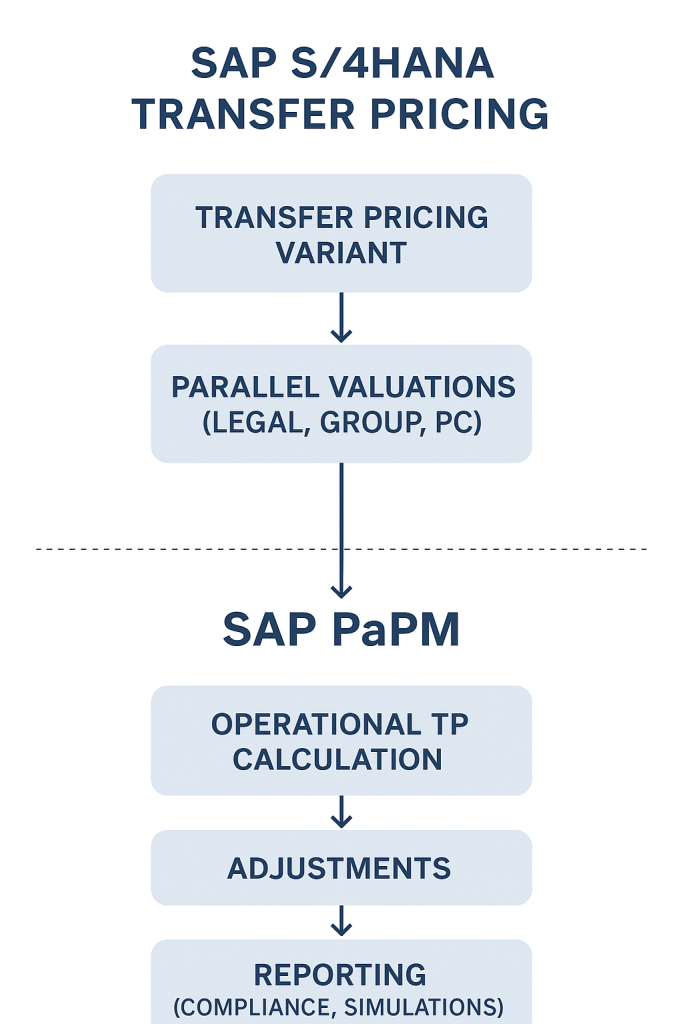
Step 1: Base Transfer Pricing in S/4HANA (UPA)
- S/4 posts transactions in Legal, Group, PC valuations using TP Variants (Cost-Plus/Sales-Minus).
- Example: Company A manufactures at 100 cost, sells at 120 transfer price to Company B.
Step 2: Data Feed into PaPM
- PaPM reads actual postings from ACDOCA (Legal + Group + PC valuations).
- It uses these as a baseline for profit before adjustment.
Step 3: Operational TP Calculation in PaPM
- PaPM applies complex allocation rules:
- Reallocate profits based on functions performed, risks assumed, and assets employed.
- Apply OECD-compliant methods (e.g., profit split based on sales volume + R&D spend).
Step 4: Resulting Adjustments
- PaPM calculates adjusted intercompany margins.
- These adjustments are posted back to S/4HANA (FI/CO) as secondary allocations or journal entries.
Step 5: Reporting & Compliance
- S/4HANA → statutory books & managerial reporting (Legal, Group, PC).
- PaPM → documentation of Transfer Pricing policies, regulatory compliance, simulations, and profitability by entity.
Here’s a layered architecture diagram (S/4 UPA at the transaction level feeding PaPM OTP at the allocation/compliance level)
🔑 4. Example Flow: Cost-Plus Manufacturing with PaPM OTP
- In S/4HANA UPA:
- Company A manufactures at cost = 100, markup 20% → Legal TP = 120.
- Group view = 100, PC view = 120.
- In PaPM OTP:
- Local tax rule requires split of profit:
- 70% to Manufacturing Entity (A),
- 30% to Sales Entity (B),
- based on “Functions & Risks” model.
- PaPM recalculates → adjusts COGS/Profit.
- Local tax rule requires split of profit:
- Posting Back to S/4HANA:
- Adjustment entry posted: reduce A’s margin, increase B’s.
- Now both S/4 + PaPM aligned with OECD BEPS guidelines.
🔑 5. Business Benefits
| Area | S/4HANA UPA | PaPM OTP |
|---|---|---|
| Purpose | Statutory & managerial multi-valuation (Legal, Group, PC) | Regulatory-compliant profit allocation & simulation |
| Methods | Cost-Plus, Sales-Minus (standard rules) | OECD TP methods (TNMM, Profit Split, etc.) |
| Data Model | ACDOCA (Universal Journal) | Reads ACDOCA + external drivers (sales, R&D, assets) |
| Adjustments | Automatic markup/margin | Multi-factor, rule-based allocations |
| Output | COGM, COGS, margin analysis | TP adjustments, compliance documentation, simulations |
✅ In summary:
- S/4HANA Transfer Pricing (UPA) = operational baseline (Legal, Group, PC).
- SAP PaPM OTP = regulatory + economic layer (complex allocations, compliance).
- Together: They provide real-time, compliant, and auditable transfer pricing from transaction level (S/4) to global profit allocation (PaPM).
Discover more from MP's S/4HANA
Subscribe to get the latest posts sent to your email.

Exceptional breakdown of SAP S/4HANA Transfer Pricing and PaPM OTP integration. Clear, insightful, and invaluable for professionals navigating complex intercompany pricing scenarios
LikeLiked by 1 person
Thankyou
LikeLike